












Model adaption of generic rotor blades for runtime extension assessments using optical 3D measurement technology and experimental modal analysis

2023-2026
Funding Federal Ministry for Economic Affairs and Energy
Subproject Optical 3D Measurement Technology:
For making of reliable wind turbine runtime extension assessments, a new method is being developed that takes into account the geometry and modal properties of the respective rotor blade. These are determined using optical 3D measurement technology. The aim is to develop of a measurement method to measure the wind turbine during operation and to minimize downtime. For this purpose, experiments are conducted on the actual installation both during standstill and while in operation.

Wind turbines are engineered for a minimum operating life of at least 20 years. A life extension is possible when the design life has not yet been fully utilized. In this project, a method is being developed that fundamentally improves conventional assessment procedures. Existing approaches rely on generic blade‑beam models, which restrict the precise analysis of the remaining service life. Rotor blades, in particular, have a decisive impact on overall performance. By accurately determining the structural‑dynamic and aerodynamic characteristics, safety margins can be substantially reduced.

The sub‑project Optical 3D Metrology at IAPG focuses on the contact‑less measurement of the geometry and structural attributes of turbine blades. To capture modal properties, several optical 3D measurement techniques are employed, enabling a precise analysis of the blades’ dynamic movements.


High‑Resolution Geometry Acquisition Using TLS

The determination of the actual blade geometry is the foundation for aero‑elastic assessments.

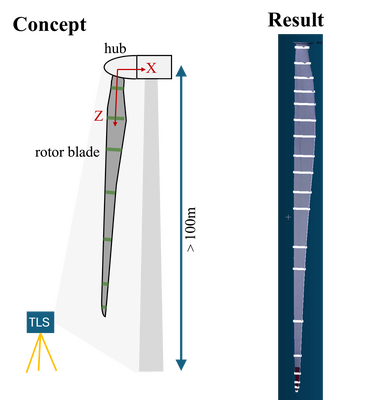
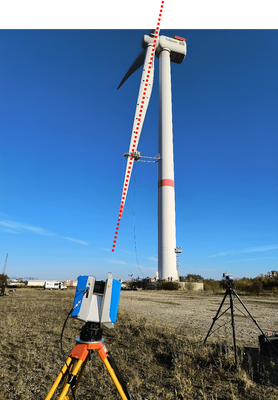
  • Methodology: Terrestrial laser scanning (TLS) is employed to capture high‑resolution point clouds of the rotor blade while it is stationary. By using multiple scanner positions, shading is minimized and a complete reconstruction is achieved.
  • Processing: The point clouds are transformed into a blade‑centric coordinate system, from which precise profile cuts along the blade’s longitudinal axis are derived.
  • Results: The method allows the determination of geometric parameters such as profile depth and local twist (Twist). Comparisons with design data show a high degree of agreement, demonstrating TLS’s suitability for highly accurate geometric inventory of large‑scale rotor blades.

Contactless Modal Analysis for Determining Vibration Properties Using Laser Scanning

A core objective of the project is the determination of modal properties (natural frequencies and mode shapes) in order to precisely model the structural-dynamic response of the blade under load.

  • Approach: To avoid time-consuming and costly measurements using acceleration sensors, a method based on TLS profile measurements was developed.
  • Implementation: The laser scanner is operated in 2D profile mode to capture blade vibrations contact-lessly. Dominant natural frequencies are identified through segment-based evaluation and the application of the Fast Fourier Transform (FFT).
  • Results: The bending modes of an 88m rotor blade were reliably determined. Deviations from the reference data provided by the Fraunhofer Institute for Wind Energy Systems (IWES) were less than 0.1 Hz. This proves that TLS represents an efficient and precise alternative to conventional Experimental Modal Analysis (EMA).

Photogrammetric Vibration Analysis and Optimization of Relative Orientation

Multi-camera systems equipped with high-speed cameras are used for the high-frequency capture of deformations and vibrations.

The Challenge:
The precise 3D reconstruction of blade movements requires an exact relative orientation of the cameras. In the field, specifically for wind turbines, this is extremely difficult due to the large measurement volumes and the often structure-poor environment (sky, homogeneous blade surfaces). Local concentrations of tie points often lead to unstable solutions and increased uncertainties, particularly in the direction of measurement.

The Solution:
To address these instabilities, the influence of the spatial distribution of tie points on the quality of the orientation was investigated.

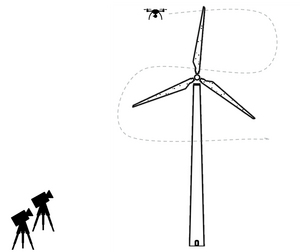
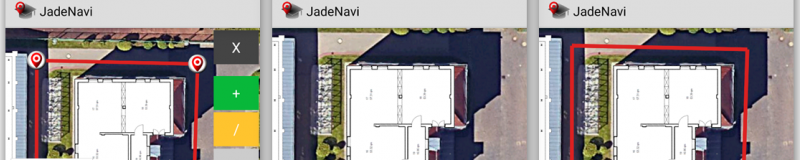
  • UAV-Supported Measurement: By deploying an RTK drone, additional, spatially well-distributed tie points were generated within the object space.
  • Results: Simulations and field tests demonstrated that it is not the number of points, but their spatial diversity that is decisive. An image coverage of approximately 60% leads to a significant stabilization of the solution.
  • Conclusion: The integration of UAV-based points enables a robust relative orientation even in structure-poor scenarios. This is the essential prerequisite for determining the vibration properties of rotor blades photogrammetrically with the required accuracy.

Books and Papers

Presentations

Entwicklung eines berührungslosen und markierungsfreien Messverfahrens zur Erfassung bewegter Rotorblätter von Windkraftanlagen

Mai 2024
Kolloquium Geoinformation